Showing posts with label Joplin Tornado. Show all posts

Tuesday, July 24, 2012

Book Review: "Joplin: The Miracle of the Human Spirit"


I was recently given a complementary copy of the book "Joplin: The Miracle of the Human Spirit" and asked to review it. It was my pleasure to read it, and I highly recommend the book to anyone with a specific interest in the Joplin tornado disaster, as well as weather related disasters (and managing and/or responding to them) in general.

The book was written by Mark Rohr, the City Manager of Joplin, and provides his own personal and professional account of the first 6 months following the disaster in Joplin.  An excerpt from the Introduction of the book describes it quite well:  "Based on a daily journal Mark kept from the beginning, the book gives the reader a behind the scenes glimpse into the priorities, the meetings, the proposals, the details, the inner workings of an organized plan to bring Joplin back even better than before."

As far as I'm concerned, the book starts off with a bang - and not one that you would expect (at least I wasn't expecting it).  From Chapter One, "A Third of Joplin in Ruins", came this revelation by Mr. Rohr (referring to that fateful day, Sunday, May 22nd, 2011):  "I had been home on the south end of the city, unaware of any threatening weather..."  Around 5:50 pm, Mr. Rohr received a call from the Fire Chief, informing him of the disaster that was literally unfolding at that time.

This revelation was incredibly disturbing to me.  I'm not blaming Mr. Rohr personally, but there was no reason that he should have been caught "unaware of any threatening weather" on that day.  Forgive me if I take this personally, but as regular blog readers know, it has literally been my business for the last 20+ years to make sure that folks in Mr. Rohr's position (as well as the public at large) are aware of impending severe weather situations so as to avoid tragic loss of life and other unfortunate outcomes.  In my opinion, the City of Joplin, including Mr. Rohr, deserved better than to have been taken by surprise by this event.  I am, of course, referring to what (again, in my opinion) was an overall poor performance by the National Weather Service on that fateful day.

Commercial Damage on Rangeline Rd. (Photo from the book)

For purposes of clarification, at no point in the book did I ever get the impression that Mr. Rohr was critical of the National Weather Service's actions on the day of the Joplin tornado.  The above opinions are mine and mine alone (and are by no means new to the regular readers of this blog).

There is one entry in the book where Mr. Rohr became agitated (again, my word, not his), by a statement from a National Weather Service employee following the event (and I believe very rightly so, as you will see below).

I almost fell out of my chair when I read this line, where Mr. Rohr was quoting the words of a member of the National Weather Service team charged with performing the post tornado "damage survey" and assigning the "official" intensity rating of the tornado.  The National Weather Service employee told Mr. Rohr (referring to the intensity of the tornado):  "I...believe it was an EF4...", and went on to say that "assigning a higher EF5 designation would be a political decision".

WHAT?????  Surely I misread that.  I reread the account at least three times, and my eyes were not deceiving me - that's what the man said.  Assigning a damage intensity rating to a tornado should never involve politics.  The pictures, videos and eye witness testimony of the damage will tell you how strong the tornado was, plain and simple.

I have long maintained that Dr. Ted Fujita, the pioneer of the U.S. tornado rating system and the world-reknowned master of performing tornado damage surveys is rolling over in his grave at the poor execution (which may be a charitable assessment) of today's National Weather Service tornado "damage survey" process.  This account only went on to confirm that suspicion in a major way.

While it is unclear what "political decisions" may have come into play, ultimately the National Weather Service rated the Joplin tornado the maximum EF5 intensity, which was overwhelmingly supported by all of the photos, videos and other ground damage survey information.

Whew.  Okay, I'll get off of my soap box, remove the blood pressure cuff and get back to the book review now...

Damage to St. John's Hospital (Photo from the book)

"Making It Up As We Go" is the title of one the early chapters.  Mr. Rohr points out that there was no "instruction manual" available to him or his staff in the aftermath of the disaster.  According to Mr. Rohr, like most cities, Joplin's Emergency Operations manual "usually consists of no more than a contacts list".  He goes on to say "I'm pretty sure the officials that draft such documents never envisioned a catastrophe of the magnitude we were facing.  By sheer necessity, we would have to make up our response as we went."

Indeed, the Joplin tornado was a catastrophe of unprecedented proportions, at least in modern times.  One of the stunning facts pointed out in the book was that 3 million cubic yards of debris were removed from Joplin in just over (an astounding) two short months following the tornado.  In the 2001 World Trade Center disaster, 2 million cubic yards of debris were removed.  

The tornado did some amazing "debris removal" of its own:  29 manhole covers, each averaging 200 pounds in gross weight, were pealed away from the earth and tossed around like toys.

We all know the devastating human toll that the tornado also took on Joplin, with 161 people having lost their lives.  A somber appendix lists the names of each of the 161 victims of the tragedy, and throughout the book Mr. Rohr, the city staff and residents pledge to rebuild Joplin better than ever before, as a tribute to those who lost their lives.

The book details another tribute that is underway, in the form of a memorial at Cunningham Park.  I had the pleasure of visiting the park just 2 weeks ago, and found myself speechless standing there in that beautiful space while at the same time staring across 26th Street at the broken down shell that was once St. John's Hospital.  The contrast was striking, and no picture or video clip can do it justice.

Waterfall at the Memorial (Photo by Rob White)

The old hospital site is being leveled, and a brand new facility is under construction in south Joplin.  The process involved with selecting the site for the new hospital is outlined in detail by Mr. Rohr in the book.

From rebuilding the High School, to rebuilding a key retail district, to rebuilding single and multiple family residences, the book gives a detailed accounting of the process (and at times, the politics) involved with getting the job done.  As you may recall, over 7,500 homes in Joplin were impacted (of which 3,500 were destroyed or deemed uninhabitable), as well as over 500 businesses.

Numerous impressive facts (did you know that over 113,000 volunteers officially registered to help with the clean-up and recovery effort), are presented throughout the book, as well as in a "summary" near the end.

As a result of working (literally) through this tragedy, Mr. Rohr and his team have developed something that they refer to as "The 10 Tenets of Disaster Management".  He shares the 10 tenets and explains them in great detail throughout the book, citing the real life examples of how each were put into practice in Joplin.

As you can probably imagine, Mr. Rohr has become a sought after speaker and adviser on managing a disaster and coordinating a recovery effort, and he honors those requests as his busy schedule allows, always putting the citizens of Joplin first.  In fact, that is the basis of tenet #4:  "Don't get seduced by the limelight - stay focused on what is important."

Again, I highly recommend this book to a wide variety of readers.  Even those with little to no interest in the weather but an interest in disaster preparedness and management will find it a very interesting and informative read.

Entire Neighborhoods Were Destroyed (Photo from the book)

As you can imagine, the recovery and rebuilding of Joplin is an ongoing process that will not be completed in a short period of time.  For that reason, I would love to see a follow-up version of the book next year (even if just published electronically) so as to update everyone on the progress that has been made on several of the key fronts that are outlined in the book.  We can, of course, obtain some of this information from the media, however Mr. Rohr's perspective from the "front lines" provides a great deal of detail and background which a 1 minute and 30 second news story simply cannot accomplish.

A portion of the proceeds of the book will go to the ongoing recovery efforts in Joplin.  If you would like to contribute in other ways as well, several suggestions are offered, including a visit to www.rebuildjoplin.org, which is a reputable a site to which we have referred blog readers since last year.

You can purchase the book at most major sources, including Amazon.com.  There is also an e-book version available for Kindle, Nook and other readers at the publisher's website.

If you would like to read more about the Joplin tragedy as reported on this blog, please see the table of contents post here.


For more information from the Original Weather Blog, including "live blogging" during rapidly changing weather events, please be sure to follow me on facebook and/or twitter:
 

Tuesday, May 22, 2012

Joplin: One Year Later. Part II: Healing, Recovery and Rebuilding Continue...


Signs like this one are all over town: A "Rebuilding Joplin" banner flapping on a fence in the foreground, and steady signs of progress in the background as a home or business is in the process of being rebuilt.

As you might imagine after such a catastrophe (over 8,000 structures were completely destroyed), it has taken awhile for the dust to settle.  Some folks have decided to pick up the pieces and move on to a new life elsewhere.  Many stayed behind and are using insurance payments, life savings, tax refunds and any other means available to rebuild and get a fresh new start in Joplin.


The scene below is particularly striking.  In this AP photo from just last week, you can see the soon to be demolished St. John's Hospital in the background, and two brand new homes under construction in the foreground:


Its a scene repeated all through the south part of town, with cleared foundations in one area and new construction underway on another:

Getty News Photo

...and yet, even one year later, there are still clear signs of the damage and destruction in several areas as well:

AP Photo

The original St. John's hospital building, which to many outsiders became "the face" of the Joplin tornado is slowly being demolished.  The process is expected to be complete by this September (due to underground mines and shafts, a quick implosion of the structure was deemed to be unsafe):

The St. John's Hospital Building Is Slowly Being Demolished

St. John's recently opened a brand new "interim" hospital under the name "Mercy Hospital", on St. John's Boulevard:

A Temporary Mercy Hospital Is Now Open

The main hospital will be rebuilt back on the original site, and is expected to be complete in 2014:

Artists Rendering of New Mercy Hospital - 2014

How can we forget the images of the Joplin High School?  I know I never will:

Joplin High School - Rob White Photo

Students attended classes at a vacant shopping mall this year, and will continue do so for the next couple of years, until the new High School is complete and ready for opening in the fall of 2014:

Artists Rendering of New Joplin High School - 2014

"Big box" retailers have reopened on Range Line Drive, and hundreds of new commercial building permits were issued by the City of Joplin through the end of April:


Wal-Mart store #59 right after the tornado (above) and with its new outlook on life in 2012 (below):


A similar story came about for the Home Depot this year.  First, a look at what little was left of the structure (where 7 people died) right after the tornado in 2011:


...and the new facility that opened this year:


The new Home Depot store includes a room capable of holding 150 people that is built out of reinforced concrete and steel.  Company officials refuse to describe it as such, but it sure sounds like a tornado safe room to me!

While bricks and mortar fly up pretty quickly these days, it will take much longer for the inner-personal wounds to heal.  Most of the folks that survived a direct or near direct hit by the tornado literally hung on for 60 to 90 seconds - which must have felt like an eternity.

As one recovery counselor in Joplin, Reverend James Patrick Ryan, recently put it:  "Those people lived through a longer period of time than most soldiers live through a firefight..."

He goes on to say:  "Before moving on, one must first come to terms with what has fundamentally changed...for many that means the loss of loved ones who, unlike homes and businesses, can neither be rebuilt nor replaced..."

Joplin Tornado Memorial

Without a doubt, it will be months or even years before many residents feel "normal" again.  Some, unfortunately, may never be able to feel that way again.  Once the media fanfare subsides over the "one year anniversary" of the event, and the grand opening of this, and the re-opening of that, it will be very important to let those folks know that they have not been forgotten, and we are in this for the long haul.

If you would like to volunteer your time or make some other contribution to the Joplin Recovery effort, this is a good place to start.


To read "Joplin: One Year Later. Part I:  Lesson's Learned (or In Progress)", go here.  If you would like to read my original post concerning the Joplin tornado, from May 22, 2011, please go here.  

For more information, including "live blogging" during rapidly changing weather events, please be sure to follow me on facebook and/or twitter:


Joplin: One Year Later. Part I: Lessons Learned (or In Progress)...

It's hard to believe that it was one year ago today that the city of Joplin, MO was ravaged by a large, violent tornado about 5 hours from the time of this writing.


By the time the horrific event was all said and done, 161 people were killed, over 8,000 homes and buildings were destroyed and over 15,000 vehicles were damaged or destroyed.  The damage payout so far has been just over $2.1 billion, and those are only the insured losses - not everyone had insurance.


The tornado cut a path generally West-East across the southern part of town.  The satellite image below (via the U.S. Army Corps of Engineers) shows catastrophic levels of damage in the red shaded areas:


The event was well forecast by the Storm Prediction Center (SPC) in Norman, OK, but it didn't seem to receive the fanfare in the media that is sometimes seen leading up to certain events, likely because the buzzwords of "widespread, outbreak", etc. weren't used to describe the situation (rather, it was deemed to be a local/regional threat).

The tornado probability forecast issued just after Midnight that Sunday morning placed the Joplin area within the region favorable for "significant" tornadoes.  A Public Severe Weather Outlook was issued at late morning that specifically described "Southwest to Northeast Missouri" as being within the danger zone:


A Tornado Watch, including the City of Joplin, was issued at 1:30 PM, just over 4 hours before the tornado struck.  The wording of the technical portion of the watch indicated that strong tornadoes were possible (click to enlarge):


While the forecast did give citizens a "heads-up" that trouble was brewing for later in the day, the warning situation concerning the Joplin event was a different story entirely.  In my opinion it was an abysmal failure which, at least in part, lead to the high death toll that was witnessed in Joplin.  Here are just a few of the major problems with the warning process on that day:

-Tornado warnings and follow-up statements incorrectly indicated the location and direction of movement of the tornado and/or parent thunderstorm.  This lead citizens to believe it would be the northern part of town that would be affected, which was the complete opposite of reality.

-Tornado warnings and/or follow-up statements did not describe the situation as dire or the tornado as large and/or destructive until the tornado had completely passed through the city (despite the fact of strong radar indications and spotter reports of a destructive tornado in progress well before that time)

-Prior to May 22, 2011, the NWS had issued 24 consecutive tornado warnings for the City of Joplin and Jasper County, MO.  Not one tornado was ever reported in those 24 warnings.  The public had little to no confidence in the warning product, and given that performance record, who can blame them?

-The City of Joplin had a policy of sounding the outdoor warning sirens very liberally.  Not only were all sirens sounded throughout the city regardless of where a particular threat was located, but they often sounded them for events other than tornadoes, such as "strong winds", etc.  This basically lead to the citizens being trained to ignore the sirens altogether.

Without a doubt, more than 161 would have perished had a warning not been issued at all.  With that said, the death toll did not have to be that high, and would not have been had the warnings been properly issued and the message properly conveyed.

A study by University of Oklahoma researcher Kim Klockow indicates that even those who received and "believed" in the warnings did not necessarily take immediate action (or in some cases, any action at all):


I agree that a critical task is at hand for those in the severe weather warning business, from meteorologists and the media, right down to local officials:  we must convey warnings and follow-up information in such a manner that end users:  (1). clearly receive the message, (2).  clearly see that there is an imminent threat to their lives and/or property and (3).  quickly act on that threat and seek shelter.

Unfortunately, the bottom line on the warning problem is that until we have the above task mastered, we're likely to see repeats of the Joplin death toll in the future.

On a much more positive note, much progress has been made in Joplin over the past year.  I'll have another post on that later this afternoon...

If you'd like to read my original post on the Joplin event from last year, please go to this link.  Until March of this year, it had been the #1 most read blog post in the history of The Original Weather Blog.  


For more information, including "live blogging" during rapidly changing weather events, please be sure to follow me on facebook and/or twitter:


Friday, December 23, 2011

#3 Weather Disaster of 2011: Joplin Tornado and Associated Outbreak (May 21-26)...


If you're like me, when you think of May 22, 2011, your mind immediately turns to Joplin, MO and the tragic EF-5 tornado that changed that community forever (photo above courtesy twisterchasers.com).  It's hard to believe that the Joplin tornado was just one of over 180 confirmed tornadoes that took place during the period May 21-May 26, 2011.  The events of those 6 days caused $9 billion in property losses, placing it in the #3 spot for billion dollar weather disasters in 2011.

By far, the Joplin tornado was the deadliest and most damaging event of that week.  Over 160 lives were lost, with over 1,000 people injured.  Thousands of single family residences and hundreds of businesses were destroyed or heavilly damaged.  Insured losses in Joplin are currently estimated to approach $4.5 billion, or roughly one-half of the total damage caused by the events of that week.  

The Joplin tornado cut a swath of damage and destruction from West to East through the center of town:

US Army Corps of Engineers Satellite Damage Survey

NWS Ground-Truth Damage Survey

As you can see by examining the NWS damage survey on the image immediately above, nearly 50% of the tornado's track (which was over 1 mile wide at times) through Joplin produced EF-5 damage, with winds in excess of 200 mph.

The doppler radar velocity (wind speed and direction) image below is tightly zoomed in on the tornadic circulation as it passed the high school:


The radar signature within the white circle indicates a 210 mph wind taking place at the surface at that time.

A "debris ball" signature was frequently noted on radar reflectivity in association with the Joplin tornado, as debris were being lifted up and carried along by the tornado and surrounding circulation:


For more detailed information on the radar imagery associated with the Joplin tornado, please refer to this post.

As alluded to above, the damage in Joplin was extreme.  I was invited to visit the city and survey the damage just one week after the tornado took place.  I was equally horrified and gratified by what I saw.  Horrified by the real-life images of destruction (and yes, death), and gratified to see the "we will survive, we will rebuild" attitude of the vast majority of the folks that I had the pleasure to meet.

I have extensively documented the Joplin tornado event (including a very personal story of survival from a gentleman named Sam) as well as the ongoing recovery in posts throughout the year on this blog.  You can go to my Joplin Tornado Table of Contents post to view and/or read the related articles.

One of the most impressive (if that is the right word) sites that I observed while surveying the damage in Joplin was this brick home that was picked up off of its foundation and moved 8 feet before being sit back down:


You can clearly see the displacement in the photo below.  I have noted the distance from the outer most basement wall to the point where the home was laid back down, which was just over 8 feet in length:


The home above was located to the West of Main Street between 20th and 25th Streets (I won't reveal the exact location out of privacy concerns for the family).  Like the majority of the other homes on the block and in that neighborhood, it had a basement.  Conventional wisdom always says to seek shelter from a tornado in your basement, which is certainly good advice in most cases.  However, in the case of the Joplin, most of the basements in the direct path of the monstrous tornado were filled with debris as homes were lifted off of their foundations.  The image below is a look down into the basement of the same house that was moved 8 feet off of its foundation:


As you can see, bricks, concrete blocks and other parts of the frame crashed down into the basement below.

A similar result took place just two blocks away at Sam's home, but he had a tornado safe room in the corner of his basement which prevented him from being crushed and/or trapped by debris (see his remarkable story here).

I am planning a more detailed post regarding the basement sheltering issue in the near future, but I think the important take away, in a nutshell, is to get underneath a workbench, the stairway or some other sturdy piece of furniture (preferably one that is fastened to the ground) even when you seek shelter in a basement.  If you have room in your basement and can afford it, I would also suggest that you look at having a tornado saferoom built into one of the corners for added protection.

Meanwhile, the recovery in Joplin continues, and will do so for many months if not years to come.  The image below is just one of hundreds of "before and after" scenes that are taking place across the community:


As I mentioned off the top of this post, while certainly the most severe, the Joplin tornado was not the only event to take place during the $9 billion disaster week of May 21-26, 2011.

The events of that week actually began the day before, with an EF-3 tornado near Reading, Kansas:


Severe damage was reported with at least 20 homes destroyed and 1 person killed in Reading.  "Hundreds" of homes and businesses were reportedly damaged in association with the tornado.

The Reading tornado was one of 22 tornado reports that took place on May 21, 2011 (red icons on the image below):


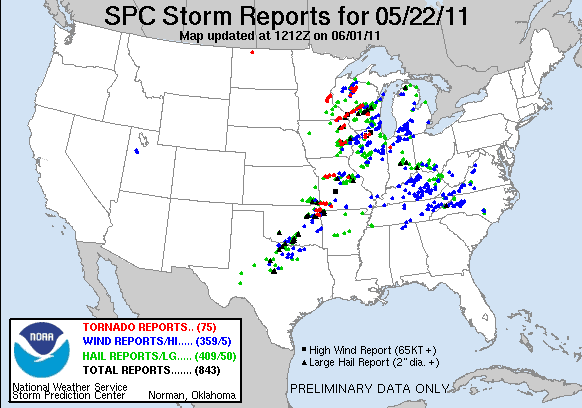
The Joplin tornado on the 22nd was one of 75 reported tornadoes that day:


On Monday the 23rd, the focus shifted to the Midwest and Ohio Valley, where the majority of 22 reported tornadoes took place:


Most of the tornadoes on the 23rd were of EF-0 or EF-1 intensity.  An EF-2 tornado was reported near Kellerville, Pennsylvania, and another was reported near Dover, Tennessee.  There were no deaths or serious injuries on this date.

A very active day took place on Tuesday the 24th, mainly over Oklahoma.  A total of 57 tornado reports were received on that day: 


An EF-5 tornado tracked from near Hinton to Guthrie in central Oklahoma (image below via NWS storm survey):


Nine people were killed as a result of this tornado, which is shown below when it was near Calumet:


Preliminary information from a scan of the tornado by the "Doppler on Wheels" research team suggests that peak winds were in excess of 210 mph with this tornado. This tree on the North side of El Reno was debarked, a phenomenon that we saw a lot of in Joplin, and is indicative of the most intense tornadoes that take place on earth:


When the tornado passed near the Oklahoma Mesonet weather observing station near El Reno, a peak wind gust of 151 mph was recorded, along with a dramatic drop in barometric pressure:


Another intense tornado tracked from near Chickasha to the south side of Oklahoma City (near the Newscastle area) on that day.  It was rated EF-4 intensity and resulted in 1 fatality (image via NWS storm survey):


The photo below shows the tornado when it was near Chickasha:


This particular tornado took a track just South of the devastating tornado that struck Moore in May of 1999.

Another EF-4 tornado tracked from near Bradley to Goldsby, just to the South of the Chickasha tornado track:


The photo below shows that particular tornado near Goldsby:


Late that evening (around Midnight) and into the pre-dawn hours of the 25th, an EF-3 tornado struck and did extensive damage to the town of Denning, Arkansas.  Most of the homes and businesses in Denning were extensively damaged or destroyed, and 4 people were killed.  The same storm produced another tornado a short time later near Clarksville, AR, where 1 person was killed.

Another big tornado day followed on the 25th, with 127 reports received:


While tornadoes were numerous and light to moderate damage was relatively widespread, the intensity of the tornadoes were less on that day - and no one was killed or seriously injured.

The strongest tornado, of EF-3 intensity, tracked from near Grandin to near Buckhorn in Missouri (image below via NWS storm survey):


The tornado rampage slowed considerably by the last day of the event, the 26th, with 16 reports received, mainly across the Ohio Valley and/or Northeast:


There were no fatalities nor any significant injuries on this date, and most of the tornadoes were of EF-0 or EF-1 intensity.  A strong tornado, rated EF-3 intensity, did take place in extreme southeast Louisiana, near Sun.

To return to the original post containing a recap of the record number of billion dollar weather disasters in 2011, please go here.


If you enjoy reading 'The Original Weather Blog', please be sure to "like" our facebook page!